Sunday, April 29, 2007

Post structuralist Media Education?

One of the key ideas I have been grappling with for my PhD is the question of what underpins media education on a theoretical level. This relates to the theory I believe underpins the relationship between young people and media and how education might productively intervene in that relationship.

Structuralist thought has been seriously challenged as a convincing theory because it assumes that society is inherently structured through relationships of domination. For example, the media dominates the beliefs and values of young people, and the role of media education is to somehow release individuals from that domination. However, numerous theorists have demonstrated that the relationship is not nearly so neat. For example, during the 1970s cultural studies theorists used French post structuralist theories to argue that individuals negotiated meaning with media texts in an active and constructive manner. While ideology and social regulation played a role in how individuals participated with media, they also had agency and helped to define the meaning of media texts.

My research aims to identify whether or not particular post structuralist theories might convincingly describe the relationship between young people and media. In particular, I am using Judith Butler's theory of perfomativity to identify how students perform their identities in relation to new media forms such as video games.

Wednesday, April 25, 2007

Media in English Curriculum

In Queensland, media education is part of the English curriculum in years 1-12 as well as being a separately recognised curriculum area in its own right, within the Arts.

The review of the Senior phase of learning in Queensland raises some questions about the form media should take if it continues to be part of the English curriculum. As part of the English field, media studies is always going to have a focus on textual analysis, because that’s how English is defined. The focus is on languages, representations and sometimes audiences. There is no focus on critical responses to institutions or technologies. There is no articulation between production and critical response. Therefore, it cannot be assumed that students who wish to specialise in Film/Media in senior can cover the “theory” component in English - as it has sometimes been suggested.

Given political pressures to go back to basics in English, the media element within English may also be at the mercy of the political preferences of the day. It is possible that it might simply disappear from English curriculum at some stage. Another concern/possibility is that so-called “non-academic” students may be streamed into the media electives, and the “academic” students encouraged to select the literature electives. This would demonstrate a significant misunderstanding of contemporary media education.

Any move to have students study media across different curriculum areas to make up a kind of "Media" major will be flawed if it does not recognise the need to closely intergrate the production and critical response / reflection aspects of media education.

Tuesday, April 24, 2007

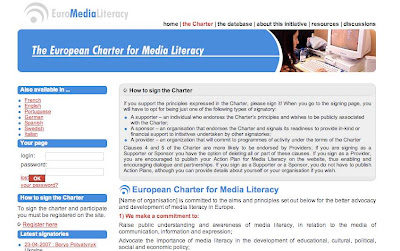
The European Charter for Media Literacy


The European Charter for Media Literacy aims to outline a broad consensus about how media literacy should be defined and asks for a commitment from individuals to support its implementation throughout Europe.

While this had the potential to be restictive, had media literacy been defined in narrow and prescriptive ways, in fact it offers much room for flexibility. Broadly speaking it defines media literacy in ways that are familiar to media educators in the UK, Canada, Australia, New Zealand and other countries with well established histories in this area.

The focus is on:
- critical conceptual understanding
- creative and reflective particiaption
- skills development with new technologies
- citizenship
- broad experience of diverse media


Website: The Charter for Media Literacy states:

1) We make a commitment to:

Raise public understanding and awareness of media literacy, in relation to the media of communication, information and expression;

Advocate the importance of media literacy in the development of educational, cultural, political, social and economic policy;

Support the principle that every European citizen of any age should have opportunities, in both formal and informal education, to develop the skills and knowledge necessary to increase their enjoyment, understanding and exploration of the media.

2) We believe that media literate people should be able to:

  • Use media technologies effectively to access, store, retrieve and share content to meet their individual and community needs and interests;
  • Gain access to, and make informed choices about, a wide range of media forms and content from different cultural and institutional sources;
  • Understand how and why media content is produced;
  • Analyse critically the techniques, languages and conventions used by the media, and the messages they convey;
  • Use media creatively to express and communicate ideas, information and opinions;
  • Identify, and avoid or challenge, media content and services that may be unsolicited, offensive or harmful;
  • Make effective use of media in the exercise of their democratic rights and civic responsibilities.

3) We will contribute to the development of a media literate European population by offering, or enabling others to offer, opportunities for people to:

  • Broaden their experience of different kinds of media form and content;
  • Develop critical skills in analysing and assessing the media;
  • Develop creative skills in using media for expression and communication, and participation in public debate.

4) We pledge to support or participate in research that will identify and develop:

  • Better understanding of what it is to be media literate;
  • Effective and sustainable pedagogy for media literacy;
  • Transferable evaluative methods and assessment criteria for media literacy.

5) We agree to undertake, or enable others to undertake, the following:

  • Build links with other signatories and contribute to the growth of a European network for media literacy;
  • Identify and share evidence of the outcomes of media literacy initiatives which we undertake or are associated with;
  • Work to make content legally available to be used for media education purposes.

6) We wish to be listed on www.euromedialiteracy.eu as:

  • A Supporter of the European Charter for Media Literacy*
  • A Sponsor of the European Charter for Media Literacy*
  • A Provider under the terms of the European Charter for Media Literacy*

As a provider, we commit to developing a timed and costed organisational Action Plan for Media Literacy, which will implement the Charter commitments we have made. We will publish our Action Plan on www.euromedialiteracy.eu.

Tuesday, April 17, 2007

Media and Technology education

The review of the senior curriculum in Queensland seems to have placed media alongside English education, Design education and Production and Performance (see previous post). However, it does not make a link to Technology education. This is interesting because media has often been associated with Technology education - for example the National curriculum review in the early 1990s associated media with English, the Arts and Technology.

I think media's most natural home is within the Arts, but I also think there are significant ties to the English and Technology learning areas. I would be concerned about a senior curriculum based on "fields" of learning that did not make the connection between media and technology education for two reasons:

The first is that media education has a lot to offer technology education. Increasingly, aspects of technology education include design and productions processes - for example in the case of multimedia production. However, students are rarely required to critically reflect on the social & cultural aspects of the products they are developing. Media educators are experts in these processes, and could collaborate with technology educators to make technology education more authetic and critically reflective - to offer electives within the Technology field that do this.

Secondly, I believe the technology knowledge and skills gained within media education courses like Film, Television and New Media are often undervalued and unrecognised. Obviously, the main goal of media education is to help students become critically reflective participants in media culture as both producers and users of media. However, along the way, they develop quite sophisticated technology skills and knowledge. For example, media educators have been producing digital videos for many years, something Technology educators are now treating as cutting edge and innovative.

I would think that a technology education "field" would therefore benefit from some focus on production from a media education perspective. Also that media education classes would be given more recognition as places where ICTs are engaged with and technological literacy developed.

Of course this creates a significant dilemma - the more areas of the curriculum media is identified with, the more potential there is for it to become less developmental in a cohesive way.

Sunday, April 15, 2007

Where does media fit in the curriculum?

Here in Queensland we currently undergoing a review of senior curriculum offerings. The preferred new model will see the number of individual subject offerings reduced, to be replaced with "fields" of learning. This has significant ramifications for the senior subject "Film, Television and New Media" which was first introduced as "Film and Television" in 1981.

No one knows quite what the new fields will be, but the QSA will soon begin consultation with teachers and interested groups, and has invited people to specific meetings which seem to suggest a possible structure for the "fields". FTVnm teachers have been invited to attend three different meetings - the "Production and Performance" group, the "English" group and the "Design" group. This contrasts with music teachers who have been invited to just one group - Music.

This seems to suggest the Queensland Studies Authority has little sense of where FTVnm belongs in the curriculum. There is a real danger that it will be come a series of semester based electives - competing with other electives under the "fields". It is possible / likely that students will no longer study 4 semesters of FTVnm across two years. This will mean less depth of understanding, less skills development and (mostly crucially) fewer opportunities to make connections between conceptual understanding and practical production work.

This has some way to run, and is likely to become the main battlefront for passionate media educators in Queensland over the next year, as we are yet again forced to justify our existence.